Thursday, April 26, 2012

Pre-Operative Meditation

       In a few days, on May 2, for a few hours, I will be going under the bright lights of an operating theatre in the hospital near where I live. Naturally, I’m scared. Fortunately, I have the best possible team of surgeons and healers, well-prepared to replace a faulty valve in this sixty-five year-old heart. I’m kind of amazed at the number of people we know who’ve had this or another heart surgery. So, it’s comforting to see that our survival and recovery statistics are quite high. But, it’s also frightening that we are so many.
      This week I have received many kind wishes and promises that prayers will be offered for me. I thank everyone for prayers, good will and positive energy. I would like to ask that you also offer a word of prayer and blessing for the pig whose life is sacrificed for my sake. I hope he or she had a good life and was spared the suffering of a slaughterhouse. Unless you’ve spent some time with pigs, you probably don’t realize how intelligent and gentle they are. And, pigs have a long history as the sacred property of the Goddess and her priestesses. The pig is the animal associated with Virgo, my birth sign, as it happens.
      I am keenly aware that this procedure is extreme. And I recognize without it, a major stroke or heart attack is likely, soon. As with much in medical science, there’s a critical threshold number for cardiac efficiency, measured as the “ejection fraction.” My heart has crossed into the danger zone. Admittedly, cigarettes have likely hastened the process, but let’s hold addiction for another time.   
     What I want to say has to do with praying, something I’ve been intrigued with ever since I realized that my Christian classmates prayed to Jesus, a Jewish rabbi, but I prayed to God because I was Jewish. This was confusing because we seemed to pray for the same things, but in different ways. I prayed for my Grandmother when she was sick. I prayed for good grades. I prayed for victory in the next game. Some prayers were answered, from time to time. Basically, it seemed to me, prayers were like magic spells you said to make your wishes come true. Although I prayed for the war in Vietnam to end and that my draft number might be very high, neither came to pass. At that point, I stopped to take a look at “Prayer” as a research topic. I think Jim Fadiman was a visiting faculty at Irvine, and he agreed to sign off on my “Independent Study.” Maybe it was Joe Hart….
    Anyway, over the next four years I read hundreds of prayers, ancient and contemporary, learned various chants and forms of incantation. I devoured Castaneda, Traherne, Yogananda, Black Elk, Ram Dass, The Imitation, St Francis, St Julian, The Prophet, Kabir, Rumi, The Way of the Pilgrim… I prayed and fasted and went into the mountains and the desert. In the end, of course, I gave up. I surrendered. I was forced to accept that I could go no further on this path without a guide. My ultimate prayer: Help!
     Some weeks later, I found myself in Tucson listening to some clean-cut guys talking about their 13 year-old Perfect Master, Guru Maharaj Ji, and the Knowledge they had received. The experience they described seemed impossible, but I felt I had to check it out. I posed the question to myself, “If I were living in Palestine 2000 years ago, fighting the imperialist Roman occupation, and Jesus happened to pass through town, would I have recognized him? And how would I know Who he was?”
     It seemed remote, but I went ahead and asked to receive Knowledge. The experience was more beautiful, more extraordinary than words could ever describe. That happened forty years ago, May 2, 1972. Guru Maharaj ji and Knowledge continue to be the heart, core, anchor, compass, foundation of this existence for me. He is my Teacher. He has shown me what reality is. He has shown me what I truly am. This is the perfect knowledge of the self.
     But, don’t take my word. See for yourself.
     I understand that this life is a gift. Each breath is a blessing. Each day I am here is truly miraculous. When I pray to my Lord, all I can say is, “Thank You. Thank You, Lord, for everything, for this life, these friends and family, these loved ones, these treasured days on Earth with you.”
     Amen.
Eagle Rock
26 April 2012 

Monday, January 16, 2012

OccupyLA 7

   
     A couple weeks ago I went downtown to the Superior Court on Temple for my turn on jury service. After clearing security, I joined the throng in the lobby waiting for the elevators to the eleventh floor. The first three filled and I was herded into the fourth box, one that bounced between the basement and the lobby half-a-dozen times without opening for a good five minutes. One woman, claustrophobically kept saying, “Can’t you open the doors? I want to get out.” Finally, the doors opened in the sub- basement and we got out. The floor was littered with weight-lifting stuff. We stepped over barbells and headed for the stairs, resigned to a dozen or more flights. At four, I quit and went through a door into a hall that brought me to another bank of elevators. I got off at twelve and walked downstairs to the Jury Assembly Room. The lively orientation went on for more than two hours, and two panels were called. At noon a cheer went up when we were told there would be no more panels called, so we could all go home.
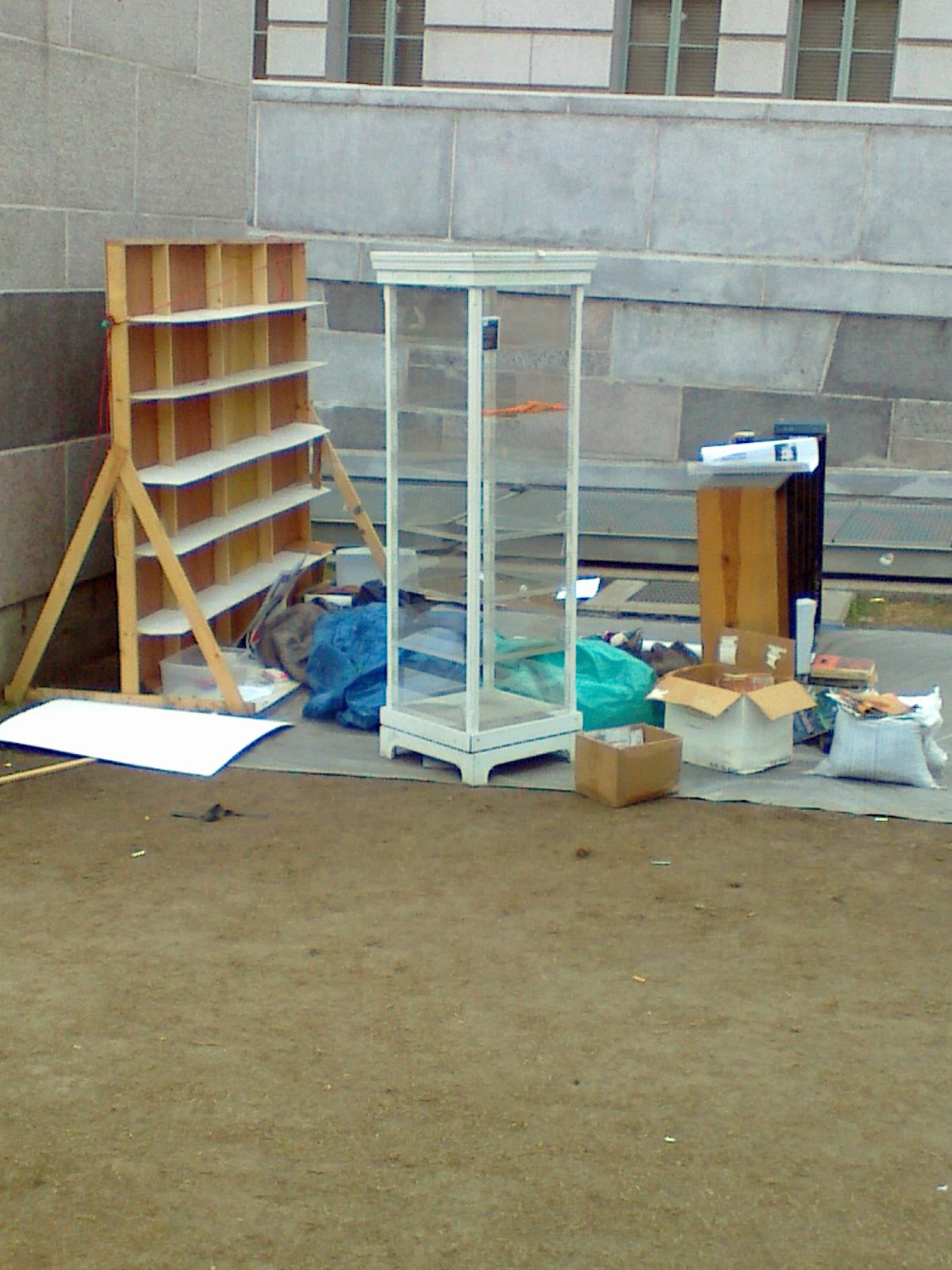
    I walked down to City Hall to see what there was to see a month after the eviction of the Occupation. I took a few pictures with my cell phone to post here. The cyclone fence and the cement bunkers effectively keep everyone out of the park and off the grounds around the building.


The place looked quite desolate, more than empty. An official from the department of parks estimates restoring the area will cost the city about $400,000. The LA Times reported that the cost to the city of removing the Occupation was more than $1,000,000, mostly over-time for police and other city services. (The article mentions that clean-up after the Lakers won the championship was more expensive.)


    That phase of the struggle is clearly no longer viable on this site without the application of force, sound strategic reasons and very large numbers. Pacifica (KPFK) reports daily on the Occupy Movement and several websites carry real-time transmissions and updates from around the country. Despite some harsh weather and police intimidation, #OWS actions have continued, but for the most part, the movement appears to have largely dispersed into office buildings, back onto campus and out into the community. General Assemblies on the steps of City Hall continue to bring hundreds together, and GAs are happening in dozens of towns. Activists from the Occupation seem to be quite mobile, marching with longshore union members to close ports up and down the coast one day, assembling in several residential neighbor- hoods to support people resisting foreclosure a couple days later.
    To my mind, the GA remains the most significant thing to appear thus far, though my attendance has been as a remote observer and reader. The salient fact is that citizens are assembling to talk about their lives, their community, their government. People are gathering in the park, in the plaza, in the agora to share their dissatisfaction about what is happening. One #OWS activist admonished people, “You don’t start a General Assembly because it’s fashionable right now. You do it because you need to talk about what’s important to you and together, figure out what you can do.” The public forum has been revitalized, amplified by the social networks available in cyberspace.


     Although there are regular meetings of the GA, marches and solidarity actions every week, it’s difficult for me to participate. There is more information on the internet than I can process and half a dozen daily emails from various movement groups. Despite being on the periphery, I hope to offer useful observations and suggestions here, as well as refer readers to material I find valuable. A recent communique from October2011.org reproduced an essay in Margaret Flowers’ blog, http://october2011.org/blogs/margaret-flowers/how-people-got-their-groove-back-what-bunch-farmers-can-teach-bunch-occupiers. I recommend it to all of us who are thinking about the next stages of the struggle as opposition stiffens and repression increases. The author (Ashley Sanders?) presents a summary of points from Lawrence Goodwyn’s study, The Populist Moment, a book I intend to borrow from the library, maybe buy.
    One more referral/reminder. Yesterday during a listening skills warm-up exercise with my class, we had a text describing the relative sizes of Jupiter and Earth and the velocity of our planet as it orbits the sun. The image of “Spaceship Earth” came to mind. Popularized on the cover of The Whole Earth Catalog, it has become part of our contemporary iconography, and one of the books in the Catalog has become a classic among futurists: Operating Manual for Spaceship Earth by R. Buckminster Fuller. Perhaps it’s a good time to have another look at Bucky’s work.
    A substantial archive of Fuller’s life and work exists, including photos, film and audio recordings, a smattering of which can be found on YouTube. In this 1974 television interview, http://www.youtube.com/watch?v=hYtQ_-rpAUo  Bucky makes an elegant digression early in the conversation. He wants to make a distinction between ‘mind’ and ‘brain.’ The brain receives data from the senses which it turns into packets of information that are stored in its neural network. The mind is the special evolutionary endowment, according to Fuller, that makes humans different from every other species. The mind’s special feature is the ability to find patterns among the information packets stored in the brain, and it is this skill at patterning that gives us  our evolutionary advantage. By understanding patterns, we are able to anticipate what is likely to happen in the future.

Parker Center, across the street from the park.
    For Fuller, the challenge eventually took the form of “anticipatory design,” based on the recognition that the environments we create and inhabit can be designed  to better anticipate and satisfy human needs, as well as modify human behavior in beneficial ways. Most of the engineering is beyond me, and some of his philosophical tenets are incomprehensible to me, but that’s okay. I’m still learning from Bucky.

Eagle Rock
December 2011 - January 2012


Saturday, December 24, 2011

OccupyLA 6

     With uncharacteristic adroitness, Chief Charlie Beck had his LAPD troops clear the park around City Hall of the Occupy Wall Street/LA encampment. Starting around seven o’clock, on the night of November 29-30, uniformed police began assembling at Dodger Stadium in Chavez Ravine, adjacent to the Police Academy. As reported on the local news, a small fleet of Metro buses carried the 1400 law enforcers down the hill to the area around the park. Wearing their riot helmets, with visors up, the police moved in around 10:30 pm. Scores of police emerged from the south entrance of City Hall about 1 am, clearing the steps and lawn around the plaza. The park was surrounded and cut off, sealing occupiers inside, preventing supporters from entering.
     The police and Occupiers held their ground for about an hour, the police repeating their order to clear the area and disperse. The Occupiers chanted, arms linked, sitting in the plaza, observed by the approved media pool and supporters kept at a distance by the police line. At 2 am the arrests began. Occupiers were cuffed in plastic and put on the buses for transport to booking and jail. According to reports given to Carol Sobel (ACLU) and Jim Lafferty (NLG), people were left on the buses for up to seven hours, in restraints, without water or access to toilets, and were forced to soil themselves.
     After the media left and live coverage ended, incidents of police assaulting Occupiers were reported. Some 280 people were arrested and charged with failing to obey police orders, a misdemeanor, but were held on $5000 bail, an outrageous abuse of judicial power. Eventually, bail was reduced and most were released on their own recognizance after a day or two.
     The park is now fenced, the debris cleared. The General Assembly continues to meet on the west side, four times a week. Committees continue to function. Actions will continue, including occupations to prevent evictions of families and marches in support of labor. People in the #OWS movement seem to be saying pretty much the same thing in the wake of the police actions that swept the country. The occupation of public space is not the point, but talking about jobs, fairness, democracy and a decent society is what it’s about. The goal for now appears to be to reach out into the communities, to educate and “broaden the base” of the movement, to form stronger alliances among students, labor, the immigrant community and the Green movement.
     When I visited the encampment (on the anniversary of the JFK assassination), I didn’t think I’d get to return. That same Tuesday evening, the City announced the park would be closed and cleared Sunday night, the 27th. The police did show up, but so did several thousand citizens. The police left, and the Occupation resumed, but the tension remained. So, on Tuesday afternoon, I went back one more time. As the pictures I took show, much of the encampment had departed, people removing what they feared the police would destroy. The stalwarts who remained had no doubt that the police would come, soon, to remove them. They were ready to resist, non-violently, and go to jail. As it turned out, the police did come that night, and the people I talked to did go to jail.
     The movement is going into its next phase. Occupations will continue, here and there, as strategy dictates. They can’t evict an idea. The teachable moment continues.
December 8-10
Eagle Rock


Sunday, December 4, 2011

Nov.29/ The day after LAPD didn't raid OccupyLA

"Last night was like a big party! Thousands of people came, and when the police showed up... no way they were gonna stop the music!"

"We know they're gonna come back to clear us out, just not when."

A tree house under construction.
Citizens wait and keep vigil.


Tree house near the main public entrance on the south plaza.

"We're working on adding another couple floors..."

Indigenous people's prayer space.

"About half the people here left. Not all of us can get arrested just now, but we'll be here when the raid comes."

Nap time inside Kid Village.

A few tents remain on the fringes.

Most Occupiers on the north lawn moved to the south side.

Untitled

... and the last word....

OccupyLA 5

    It appears my last walk around the OccupyLA encampment may have been my last walk. The front page of today’s LA Times reports that the City is about to close the park, to protect the lawn and the safety of the occupiers. The people in the park have said they will stay, and resist eviction without violence. They have declined to cooperate or negotiate further until ten conditions are addressed.  Go to the website http://occupylosangeles.org to read the statement. There are regular communiques posted, as well as transcripts of the General Assembly.     
    Yesterday, Tuesday, I went to visit the encampment again. It‘s been about three weeks since I was able to get down there, though I’ve been trying to follow things on line. The site was crowded with tents and there were scores of people around. As I walked around for the next two hours, I talked with a number of people about the encampment. Overall, spirits remain high despite the problems inherent in the situation. Several hundred people living together with minimal infrastructure (primitive camping conditions) are bound to meet some difficulties.
    As I walked into the site, a knot of people were gathered in front of the Wellness tent. Most were trying to see what was happening, snapping pictures with cell phones, as loud canine yelps came from under the huddle of humans. Apparently, a couple dogs had gotten into a fight, and this one was badly hurt. I moved away and continued on to the plaza and the steps on the south side. This is the largest open area around City Hall. Most activity at the encampment seems to begin here: announcements, food service, General Assemblies, marches, etc. A man with a megaphone was announcing a teach-in on the Federal Reserve, followed by a march at four to the LA Fed nearby.
    There are four paths into the plaza, rays converging at the steps up to the building. A few paces along the path, past the meditation tent, brought me to Kid Village. It looked pretty rough&tumble, sheets and tarps stretched over cord wrapped round palm trees, highlighted with bungees. It created a secluded space within a circle of tents, enough for a dozen children to be comfortably cared for. A six foot banquet table was stacked with beverage containers, cartons of fruit and boxes of granola bars. More behind the table, with general supplies you’d find at a spartan daycare center, a few women talking as I stepped inside.
    “May I come in?”
    “I’m sorry, but…” one of the women began.
    “He’s okay,” said another, “he’s one of the good guys. I’ve seen him here before.”
    I thanked her and we talked about what was happening in the space. At the moment, one child was full-time, living in Kid Village, being home-schooled by a teacher also living on-site. A couple more children came regularly for the afternoon, but the “boom time” was on the weekends. I could see evidence of art and craft activities, hand-made toys, an altar, but no kids. Then, a high, tentative query, “Mom?” came from the tent beside me, and one of the women disappeared inside. I thanked them and found my way out.
    Going back through the plaza I happened upon a small black tent, decked out in Star Wars ornaments. I took it to be an installation, or sculpture. Its presence there made me smile, but it did cause a twinge of malaise. On the hillside a few steps on, there was a roped off area, decorated with stones, shells, gourds and feathers, by the Indigenous People’s Justice group. As I stood there, a young woman appeared, leading a small group of people. She seemed to be guiding them around the Occupation, like a tour-guide.
    In their wake I came to a table under a tent where a big banner proclaimed “End Foreclosures!” The man I talked with behind the table had a pretty loose idea of what the demand meant, but his friend, seated on a bicycle, was quite articulate.
    “They manipulate the market,” he began. “How they do that? First they break Glass-Stiegal so banks can speculate. Then they rig the credit game and get the Fed to lower the prime.”
    “So how does that get us here?” asked the big man in the chair.
    “Look, when money is cheap, you borrow and pay less interest. And, since everything just gets more expensive, it makes sense to buy it now. Right?” said the guy with the bicycle. “So, your bank tells you that you can take a second mortgage on your home at this incredible rate, AND your home has increased in value since you bought it!
    “Now what does that mean? If you are the lender, you have created a money stream into your assets column. If you are the consumer, the borrower, you have created a money leak, losing equity as the housing market and stock market collapse. Follow me?”
    “Okay,” I said, picking up the thread, “so with the government backing the lenders and the regulators on the take, these loans were bundled and sold, with insurance, to banks around the world. As more and more borrowers failed to pay, banks began to fail and the insurance underwriters weren’t able to cover the losses.”
    “That’s when the bail-out happened,” said the big guy.
    “Right. Tax payers save the banks and the banks say thank you by foreclosing on their homes. That’s how we got here.”
    “I hope the Occupation can make that a demand,” I said pointing at the banner. We talked a bit more and I continued my tour.
 *                                             *
     Across the street on the east side, mobile units from the local TV stations were parked, waiting for a press conference to begin. On the north side lawn, tents were less densely pitched. The library was in a stage of recovery after the rain and wind of the weekend. A couple men were sorting and shelving the books, optimistic about the improved library-to-come. They directed me up the slope to the artists‘ area on the corner. The young people there reminded me a little of our cohort in the 60s, the Sherwood Forest Collective. We often had more energy and passion than good sense, and there was something familiar here as I talked with them. The silkscreen images and day-glow colors were nostalgic, as were the clothes. I don’t know what I expected, but it was disappointing to find little more than buttons, discarded posters and souvenir t-shirts on display.
    The narrow patches of lawn on either side of the west entrance are still covered with tents and clusters of Port-a-potties and trash bins. A young woman was sitting in front of the main entrance, meditating. A few yards away, an older man sat in a folding chair, speaking into a microphone held by a young woman. Finishing my circuit, I reentered the encampment and found my way through the plaza to the food tent.
    The young woman there smiled, recognized me from my earlier visits, and introduced me as “an outside activist occupier.” Didn’t I blush? She introduced me to the two young men sitting on a stack of sacks of grains. They were the camp cooks, resting after a day of making and serving food. I learned that the food was being prepared at a church in Pasadena, and offered to help on the weekend. Unfortunately, they weren’t sure about the name of the church or schedule…. As we talked, a woman with a shopping cart full of bags of dog food appeared and began portioning the kibble into baggies. As she pointed out, “Dogs have to eat too.”
    On my way past the Street Theatre tents, I learned that the people had gone to Venice, for an action. Snaking through the tents I reached the Welcome tent, behind the sidewalk Metro bench. A large dry chalkboard propped against a table listed hour-by-hour meetings and gatherings. Another listed materials and resources needed. Four or five people circulated behind the banquet tables and the makeshift shelving under the tent, talking across the tables or into cell phones. I noted that at noon there had been a non-violence training workshop.
    As I stood there, someone rushed in, “Two guys over there, with sticks,” pointing, panting. Three of the men behind the table dashed toward the scuffle, one with his cell phone recording. It appeared to be an accident, a tall man with wiry red hair was twirling his staff when a short dark-haired man inadvertently walked into the baton. Both men seemed to be “off their meds.”  I turned on the big guy and asked him, “You hurt?” He shook his head, no, and I waved him away. The other men had surrounded the injured party who really wanted to use his pepper spray on someone, but he calmed down and went away after a few minutes.
    The two hour tour had tired me, and I still had a couple blocks up hill to the Red Line. I made a mental salute to my comrades and left.
23 November 2011
Eagle Rock

Friday, November 25, 2011

Images from Occupy LA/ 22 November (part 2)


Plastic shelter/sculpture.

 Poster pinned to a tent on the south lawn.
Local media
More local media.
And more local media.
After the rain, rebuilding the library.
Library needs.
Land and Liberty.
Red pins on the map represent Occupations in the US and around the world.
Souvenirs made on site at the Occupation.
Art Center at Occupy LA.
Tents on the north lawn, library midway on right.

 The Welcome Tent near the sidewalk on the south lawn.

 The Wellness Tent on the south lawn.
Very young fur person at OccupyLA.

Images from Occupy LA/ 22 November

Homeland Security cruises past the encampment.


Across the street is the OccupyLA encampment on the south lawn of City Hall.

Entering the camp, walking toward the plaza.
The re-decorated plaza.
It is what it is. Whatever that is.
Gathering in the plaza.
Outside the media center.
Occupation residents on the south lawn.
Indigenous people's sacred space.
Do you know about Chemtrails?
Welcome to the kids' space.
Behind this wall is the Kid Village.
Inside the Kid Village.